
Finding Kirkwood Residents
Begin with a fact that carries its own date. An address fits the City of Kirkwood parcel service or the St. Louis County property search. A name tied to public business may surface in Missouri Case.net, a historic directory, or a council record. Tracing a past household takes a directory year and a map. A deed or census page often follows. A property account names a parcel and account holder. It does not list everyone living there. A directory entry is a dated lead, not a continuous residence record.
Apply a two-source rule before calling any Kirkwood result a match. Write down the source, date, and jurisdiction. That trail matters. It keeps a mailing address or a permit applicant from being mistaken for a resident. The address-first route is laid out in the Kirkwood street directory; the sequence here is the broad starting path.
- For a current address, identify the parcel and current property account first. Save the displayed tax year and whether the result labels an address as situs or mailing.
- For a known person, use a narrow official index appropriate to the question, such as Case.net for a court file or the voter confirmation form with the required identity information.
- For a transfer or earlier owner, search the Recorder of Deeds index by party and date, then retain the instrument number or book and page.
- For a historical household, select the directory year before searching the St. Louis County run or the 1910 Kirkwood index.
- When an online result ends, ask the actual custodian for inspection, a copy, or an existing index under the Missouri Sunshine Law.
Kirkwood Offices Behind Resident Records
Kirkwood keeps no single roster of every person. The City Clerk holds municipal proceedings and fields requests for city material. St. Louis County maintains the property and deed layers. The Board of Elections and the Missouri voter portal handle registration data. Courts and vital records sit with separate custodians and limits. Picking the right desk counts as much as typing the right name.
Minutes, board rosters, and permit files can place a person or address in civic context. They are not a general residents directory. For a parcel or deed, head to the county. The office cards that follow give the practical handoff points for Kirkwood and St. Louis County.
City of Kirkwood Clerk
139 S. Kirkwood Road
Kirkwood, MO 63122
314-822-5802
County Board of Elections
725 Northwest Plaza Drive
St. Ann, MO 63074
314-615-1833
Kirkwood Property Account Search
The St. Louis County Property Tax Inquiry serves as the current property entry point for many Kirkwood addresses. One field takes a number, name, or address. Pick All, Real Estate, or Personal Property from there. Results list year, property number, name, address, and type. Pages cap at 25 results. A CSV export lets you document the exact result instead of trusting memory.
| Search field | Input | Use in a Kirkwood search |
|---|---|---|
| Property Number, Owner Name, or Address | One text entry | Enter an address for parcel context, or a name when the tax account is the question. |
| Record type | Optional selector | Choose All, Real Estate, or Personal Property to narrow the current account result. |
| Result tools | Pagination and export | Keep the displayed tax year and downloaded result date with any research note. |
SLCL also documents the county IAS property search. Lookups run by locator number, address, name, or subdivision. Listings may include assessment and building details, a property sketch, an aerial photo, year built, and a deed-index list. Availability can change. Treat those extras as leads rather than guarantees. And remember what an account proves. The name on the account is a property clue, not evidence that everyone at the address lives there.
Note: The county result is strongest for a parcel and tax account, while renters, household members, and the full ownership history require other records.
Kirkwood Parcel Layers
Kirkwood's official zoning and parcels MapServer publishes three named layers: Anno Address, Parcel, and Zoning. Its documented query, identify, and export-map operations make an address check repeatable. Find the address annotation first. Record the parcel polygon and its zoning context. Then compare it with the county result. The county GIS viewer adds wider layers, but a map point by itself proves neither occupancy nor a postal delivery line.
- Parcel
- A mapped land unit used to connect an address to a tax or legal record.
- Roll
- An official list or account set created for one purpose, such as taxes or voter registration.
- Index
- A finding aid that points to a record, often without showing the complete document image.
- Criss-cross directory
- A historical directory arranged by street and house number instead of surname.
Save the parcel identifier first. Move from there to tax and deed records. That anchor keeps a Kirkwood residents directory search tied to one physical place, even when a mailing address or an old directory label differs.
Current Kirkwood Resident Sources
Current records are purpose-built, not interchangeable proof of residence. A county tax account links a name to a property. A deed index names parties to an instrument. The voter system confirms registration through protected identity fields. A city roster or meeting record shows civic participation. Each keeper, date, and access condition should stay visible in any Kirkwood residents directory search.
| Source | Who It Lists | Keeper | Access |
|---|---|---|---|
| Property Tax Inquiry | Current property account names | St. Louis County | Public web search |
| Missouri voter lookup | Registration confirmation | Secretary of State and local election authority | Identity fields required |
| Recorder instrument index | Grantors, grantees, and recorded parties | St. Louis County Recorder | Index plus terminal or copy route |
| City Clerk records | Council, boards, and municipal proceedings | City of Kirkwood | Online current material or request |
| Community organizations | Organization history and events | Independent groups | Organization-specific access |
Take the shortest official route for the question. The Kirkwood resident lookup shows how to test one well-defined name across several sources. No single result counts as identity proof. And never build a broad list from these separate systems, especially where voter, vital, or protected-address rules apply.
Kirkwood Voter Record Access
Missouri's statewide lookup is built for one purpose: confirming a single registration. Enter the first name as registered, last name, date of birth, last four Social Security digits, and a county. Kirkwood voters sit in St. Louis County. The tool is not an open residents directory, and the identity fields it collects deserve care. Never copy them into notes or publish them elsewhere.
St. Louis County's Election Information Search form does different work. It produces active-voter lists, election history, and district output. Fields cover address parts, ZIP, precinct, registration date, and chosen election dates. Fees and data options attach to each order. A commercial-use restriction also applies. Take a dated election request to the Board of Elections. Take a registration question to the state confirmation tool instead.
Missouri's official voter lookup form displays the identity and county fields an individual check requires.
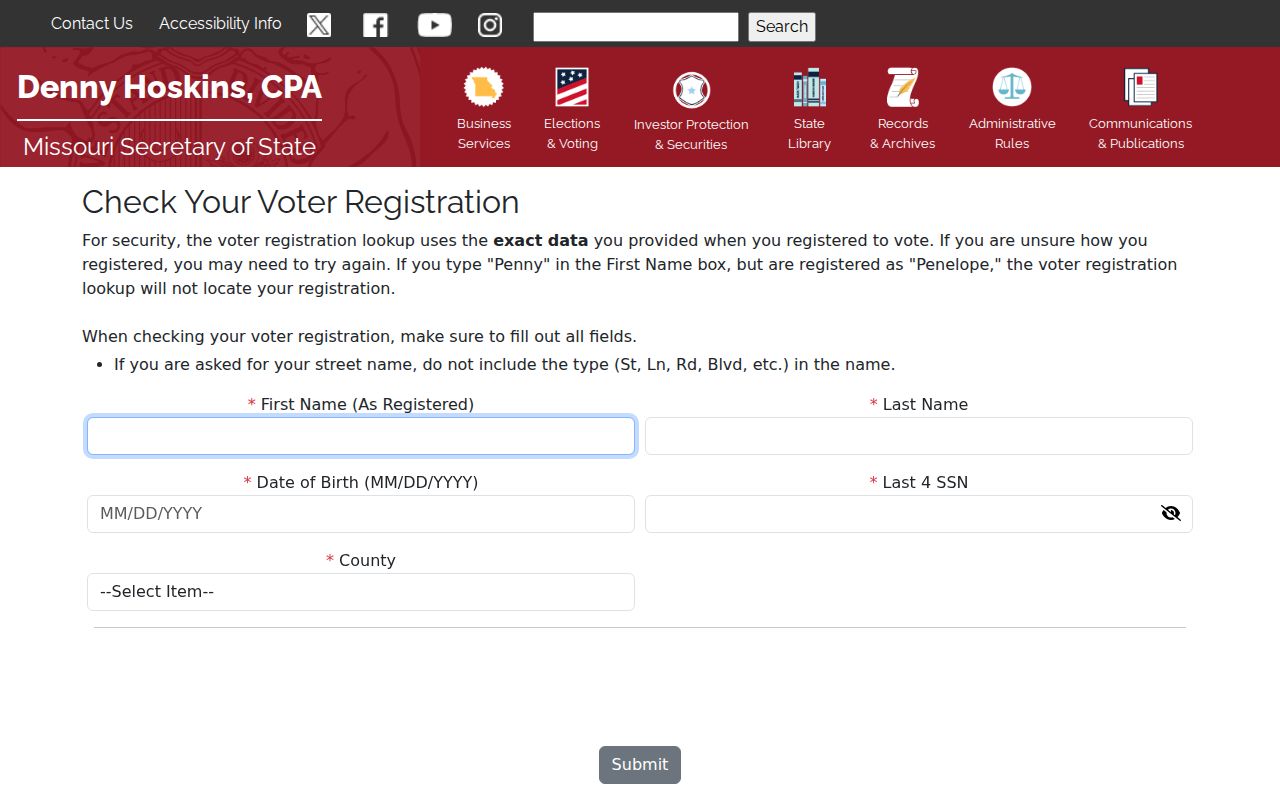
The form fits a narrow confirmation step, and only after a lawful, appropriate reason exists. Missouri law also shields addresses for qualified participants and other protected voters.
Note: Controlled access can confirm a record, but it says nothing about opinions, occupancy, or unrestricted public availability.
Kirkwood Deed Index Trail
Recorder of Deeds deed-search guidance lists the fields worth knowing. They include grantor, grantee, date, and document number. The affected book and page, book and page, instrument type, legal description, and locator or lien number round out the set. Start with a party and a date. Narrow later with a document or legal-description field if one is open. One caution comes from the official guidance. A locator number is optional and can return an incomplete result set.
An index hit is a lead to an instrument. It is not a scanned deed or a title opinion. When an image is unavailable, use a public terminal or the Recorder's copy-order form. The form takes an address, owner names, and an approximate purchase date. It also takes instrument type, book and page or document number, and a certified or non-certified choice. The published form lists $2 for the first page. Each additional page is $1. Certification is $1, subject to the current form.
Kirkwood Court Name Index
Missouri Case.net supports searches by litigant name, filing date, and case number. It also covers scheduled hearings or trials. Choose the 21st Judicial Circuit for Kirkwood matters in St. Louis County. A public result can include a case number, filing date, and category. It can also list party names and roles, attorneys, docket entries, hearing dates, and status or disposition. Keep the case number and court with anything you save.
Public documents filed on or after July 1, 2023 are viewable remotely. Court schedules and document-security rules apply. Older electronic material may need the courthouse public terminal. Confidential documents and protected information stay restricted. A name match is only a lead. Compare court, dates, and context before calling it the same Kirkwood person.
Kirkwood Vital Record Threshold
Missouri vital records are not a general public lookup. The state Bureau of Vital Records limits access to the registrant and qualified applicants with a direct and tangible interest under Missouri rules. The official application asks for record type, event identity, copies, requester relationship and purpose. It also requests identification and notarization details for mail requests. Birth and death registration starts in 1910. A death record older than 50 years can become a genealogical lead. This works through Missouri Digital Heritage.
The state route and the St. Louis County local issuer cover different date ranges. The county form lists birth certificates from 1920 forward and death certificates from 1980 forward. Follow the DHSS ordering instructions or the matching local form. Never treat a restricted event record as a way around eligibility.
Kirkwood Resident Directory Archives
Historical directories make a dated household search practical. Yet no one collection spans every year. The St. Louis County Library holds county directories in print, microfilm, microfiche, and selected digital volumes. Its run includes 1893, 1896, 1903, 1909, 1917, many volumes through the 1970s, and 1979. Gaps appear, and they matter. Search by surname or part of an address. Then browse the neighboring alphabetical pages, since OCR can miss an entry.
Reverse or criss-cross volumes lead with street and house number. An alphabetical volume can add a name, occupation abbreviation, or another dated note. Pair a directory year with a map, parcel, census, or deed. That way you avoid trusting it as a full household count. The Kirkwood city directories page carries the collection-by-collection method and access details.
Kirkwood's 1910 Directory
The Missouri Historical Society's indexed Directory of the City of Kirkwood is a direct local source. It covers Kirkwood directly. The Kirkwood Tablet published it in 1910. It holds 2,622 indexed records and accepts last name, first name, alternate spelling, corporate name, and address searches. The corporate and address fields matter here. A hit can be a firm, public utility, or institution rather than a household.
That 1910 set also shows why the index deserves a check. Its page or image supplies fuller context. A business entry, an abbreviation, and a street label all need the volume year and surrounding context. The first Kirkwood depot dates to 1853. The current historic station dates to 1893. A directory, plat, and recorded instrument can therefore form a useful local chronology. Just stop short of claiming one document proves continuous residence.
Kirkwood Protected Address Rules
Some Kirkwood addresses are shielded on purpose. Missouri's Safe at Home program gives qualifying participants a substitute address. Agencies and courts have to accept it. The local election authority never sees the participant's real address. Separate voter-address closure procedures can shield other eligible people too. Do not try to rebuild a protected address from GIS layers, property rolls, or delivery records. That gap in the residents directory is deliberate.
Lawful use. Kirkwood record research is suited to family history, civic context, property questions, and personal reconnection. Do not use any record trail to stalk, harass, intimidate, or harm another person.
Vital records follow their own qualified-access rules. Court files may be confidential or partly redacted. A responsible result in any Kirkwood resident lookup carries a precise label: indexed party, account holder, dated directory entry, or registration confirmation, never a claim to know a whole household.
Kirkwood Records Beyond Portals
Portals only go so far. The City Clerk keeps older council and board material that is no longer posted anywhere online. For county departments, the records-request portal is the fallback, once you name the department, date range, address or parcel, and record type. Missouri Sunshine Law requests go to the custodian of each record. Ask for a concrete record, index, or export. The third business day is the usual response deadline. Complex retrieval can stretch past that, and duplication or research charges add time.
Libraries and archives cover the pre-digital trail. SLCL's Kirkwood local-history index points to June Wilkinson Dahl's A History of Kirkwood, Missouri, 1851–1965 and allows up to three photocopy searches per request. Mudd's Grove hosts Historical Society research sessions by reservation. For county and municipal research that outgrows local shelves, the Missouri State Archives serves as the statewide escalation point.
One more tool belongs in the plan. The St. Louis County records-request entry point shows the account and request workflow for records that no public search interface exposes.
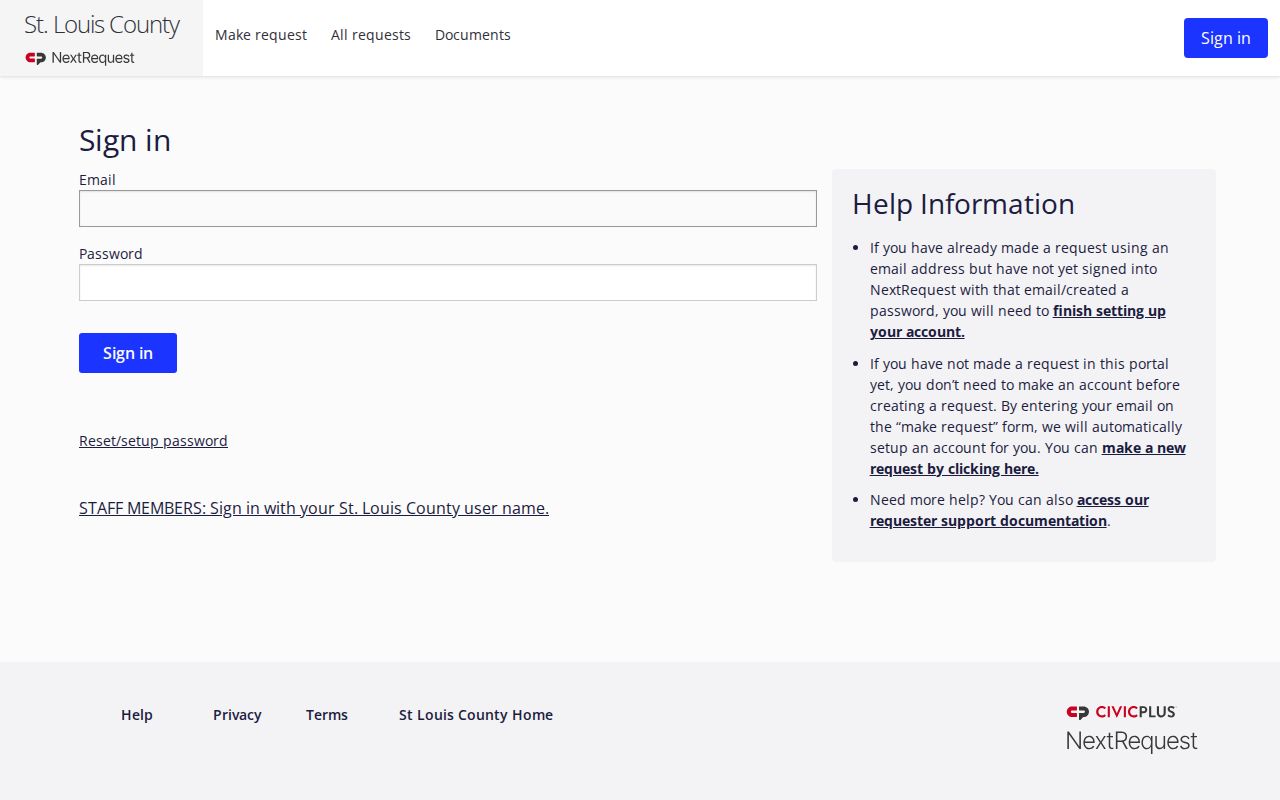
The portal notice spells out one small convenience. No account is needed up front. The email entered with a first request creates one, and a precise ask saves time for both you and the custodian.
Note: Preserve the source, the date, and what a partial result does not prove, whether it comes from a portal, a library, or a custodian.