
Sources for Kirkwood Previous Residents by Era
A backward address trail begins with the period being investigated. Current parcel data identifies the property, while deeds identify recorded transfers. Directories and census sources are the household layer, and historic maps describe the lot or structure rather than the people. The strongest answer about previous residents keeps those roles separate. For a nineteenth-century address, start with map, deed, and directory leads. For a later address, add the ownership index, reverse directory, and city permit or landmark context where it fits the date.
| Source | Years it covers | Where held | What it can show |
|---|---|---|---|
| Current parcel and tax account | Current tax record | St. Louis County property search and GIS | Property number, account name, address, and parcel context |
| St. Louis County deeds | 1877-1931 collection lead | SLCL and Recorder of Deeds research routes | Recorded parties, instruments, and legal descriptions |
| Property ownership index | 1974-1992 | SLCL PastPorts lead | A bridge between current and earlier ownership research |
| County directories | Selected volumes, 1893-1979 | SLCL print, microfilm, microfiche, and digital collection | Names, addresses, and street-first leads where available |
| Kirkwood Tablet directory | 1910 | Missouri Historical Society index | Local names, addresses, and corporate-name entries |
| Atlas, plat, and Sanborn leads | 1878, 1909, and 1926 | Library and National Register research sources | Lot, street, footprint, and structure context |
The public trail is uneven. A year in a collection description is not proof that every image is online. Keep a gap in the timeline visible rather than filling it with an assumption.
Kirkwood Previous Residents Start at the Parcel
Before looking for past residents, pin down the property. Search the St. Louis County Property Tax Inquiry by address, owner name, or property number, then use the Kirkwood parcel and zoning service to identify the parcel geometry and address annotation. Save the situs or property address, parcel or locator number, tax year, account name, and any separate mailing field. The county result pattern includes year, property number, name, address, and record type.
Keep the situs address and a taxing or mailing address in separate notes. The situs identifies the parcel. A mailing field identifies where tax correspondence goes, which can be somewhere else. An account name also is not a list of everyone who lived at the address.
Kirkwood Previous Residents Through a Deed Chain
Recorded owners are one part of a past-resident search. Use the parcel details to begin a chain of title, meaning the sequence of recorded instruments that connects owners over time. The St. Louis County Recorder of Deeds deed-search instructions point researchers to party and date searching. Record the instrument date, recording date, grantor, grantee, legal description, and book/page or document number. An index is not the deed image and does not supply a title opinion.
- Save the current parcel identifier, situs address, and legal description from the property and GIS layers.
- Find the deed into the current recorded owner using the party name and date, then copy its instrument details.
- Search the seller as grantee to find that person's earlier purchase, checking the legal description each time.
- Repeat the recorded-transfer sequence backward and flag any gap, estate matter, plat, lien, release, or easement.
- When an image is not online, use a public terminal or the Recorder copy-order form with book/page, document number, address, name, or date.
- Grantor
- The party transferring an interest in a recorded instrument.
- Grantee
- The party receiving that recorded interest. Searching a prior owner as grantee can locate the earlier purchase.
- Legal description
- The lot, block, subdivision, or other parcel wording in the instrument. It can remain more stable than a street label.
Earlier material can require a library collection, a public terminal, or a copy order. Keep each transfer in date order and distinguish a recorded owner from a directory-listed occupant.
Kirkwood Previous Residents Need a Target Year
Choose the year before choosing a source. A directory, census item, deed, permit, or map only describes the period it covers. A directory entry from one year and a deed from another may both be useful, but they should not be written as if they describe the same day. Place each source on a simple date line and say whether it names an owner, occupant, business, or structure.
There is no verified broad Kirkwood street-renumbering or renaming schedule in the source material. When an old address looks different, compare the recorded legal description, parcel polygon, plat lot and block, cross streets, dated directory form, and Sanborn context. Do not assign an old number to a current house without that support.
Note: A missing year is evidence of a coverage gap until a dated source, not a best guess, links the address forms.
Kirkwood Address Maps and Structure Clues
Maps help establish the setting for previous residents without pretending to name them. The National Register material for the Way/J. W. and Mary House cites the 1878 Pitzman atlas, the 1909 St. Louis County plat book, and a 1926 Sanborn Map of Kirkwood. Together, those leads can help compare a lot, block, street pattern, or building footprint across eras. A permit, landmark, or district file may add structure information, yet it needs a dated directory or other named source before it becomes evidence about an occupant.
The City of Kirkwood historic-preservation page identifies nine local districts and 85 designated landmarks. Its map context can narrow the setting for a house-history question, while a dated parcel, deed, or directory supplies the person link.
Past Kirkwood Households Beyond Ownership
Directories and census sources address a different question from deeds: who was listed with an address at a date. SLCL's county directory collection has surname and address searching, browsing, and reverse-directory leads, while Kirkwood Public Library points to HeritageQuest census and local obituary resources. Read a street-first result alongside the alphabetical entry. The fuller collection history and entry-reading method appear on the Kirkwood city directory collections page.
- Pick the directory volume closest to the target year and save the printed spelling, street form, and page or image.
- Check the reverse or criss-cross section when the volume has one, then match its street entry to the alphabetical listing.
- Use the census source that fits the date range to test the household and address context, not to replace the directory date.
- Search obituary, cemetery, or probate leads only as dated context for a person who is no longer living at the address.
Disappearance from a directory can reflect a move, death, marriage or name change, non-enumeration, or a missing book. It does not identify the reason by itself.
Kirkwood Previous Residents and Online Gaps
Online does not mean complete. Selected SLCL directories and the MHS index can be searched from home, but older microfilm, recorder images, historical-society holdings, and oral histories may require a library visit, a public terminal, a reservation, or a copy request. The official county material did not establish a verified earliest live online-index cutoff. State that limit plainly instead of attaching an unsupported cutoff year to the recorder search.
Older county deeds have several documented research routes: SLCL identifies county deeds from 1877 to 1931, FamilySearch county deeds from 1877 to 1886, and a property-ownership index for 1974 to 1992. These are collection leads, not guarantees of a complete online image for every transaction.
Note: Record the repository, format, volume or year, page or image, and access date so another searcher can revisit an incomplete trail.
Kirkwood Previous Residents and Local History Requests
No official Kirkwood-specific house-history form was located. The closest documented option is the SLCL Kirkwood local-history index, which identifies June Wilkinson Dahl's A History of Kirkwood, Missouri, 1851-1965. The library holds a reference copy and a circulating copy, and limits remote photocopy requests to three searches per request. Give staff the exact address, target era, parcel or locator if known, and the type of source sought.
The Kirkwood local-history index is the documented route to Dahl's local history and its name and topic index.
Library reference help can identify a catalog, index, or finding aid, then point to a branch visit or copy request when no digital page is available. The Emerson History & Genealogy Center at the Clark Family Branch has about 125,000 history and genealogy items, FamilySearch screens, a Memory Lab, and a digitization room for questions that reach beyond a web index.
The Kirkwood Historical Society at Mudd's Grove also offers tours and library research sessions by reservation. Its local collections can supply context, while dated deeds and directories remain the records that connect a person or transfer to an address.
Kirkwood Previous Residents Across Jurisdictions
Place names and governments changed around the records. St. Louis City and County separated in 1876, so a historical St. Louis label may need a county or city check before it is carried forward to a modern Kirkwood address. Meacham Park was annexed to Kirkwood in 1991. For a record before that date, retain the jurisdiction named by the record and then add later city context separately.
Kirkwood's local history also reaches through different custodians. The Missouri Digital Heritage Journeys into Kirkwood History collection includes photographs and documents from the Kirkwood Historical Society, with records reaching back to 1863 and bulk material from the 1970s and 1990s. Rights and reproduction restrictions still apply to individual items.
The Journeys into Kirkwood History collection provides a visual and document-based local-history access point.
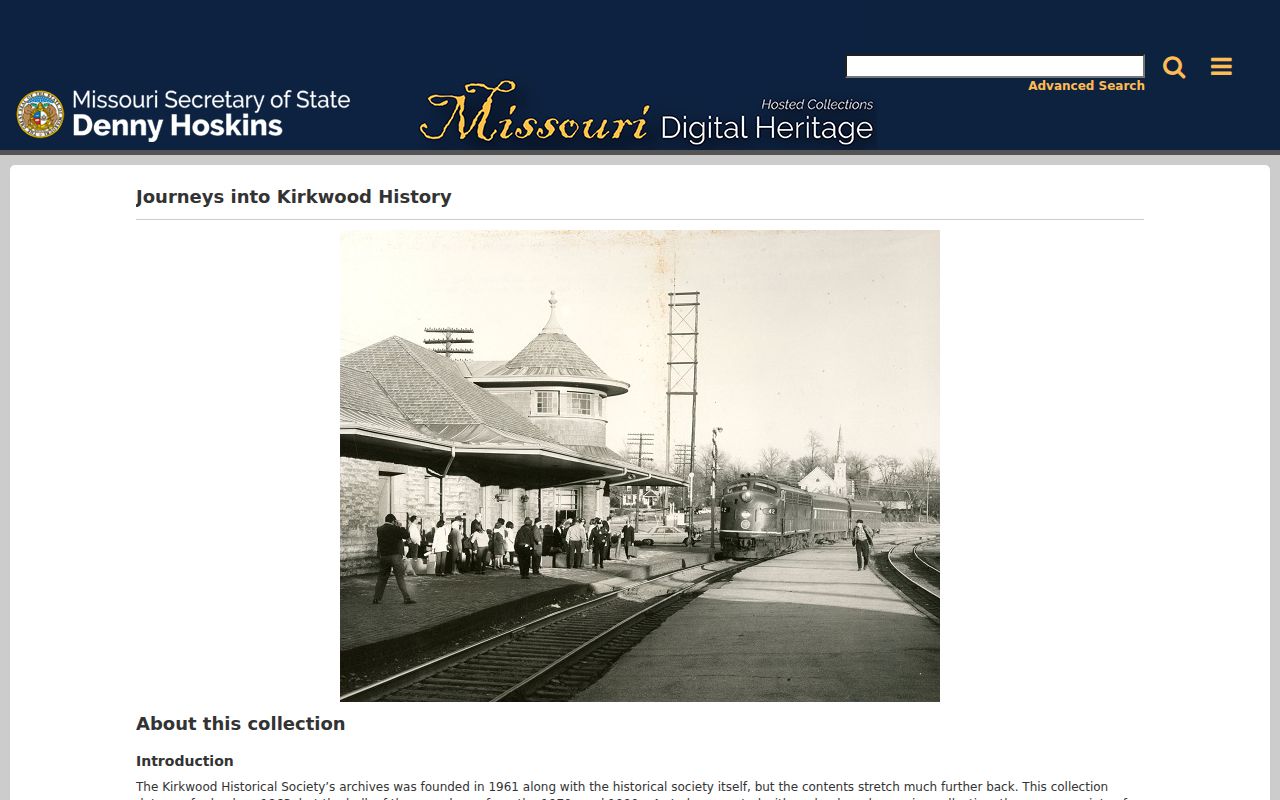
Use a photograph, oral history, or local-history item as context for the address trail, then keep the dated directory or deed separate as the record that names a person or transfer.
Note: Keep the date and original jurisdiction with a Kirkwood address before combining city, county, and historical repository records.